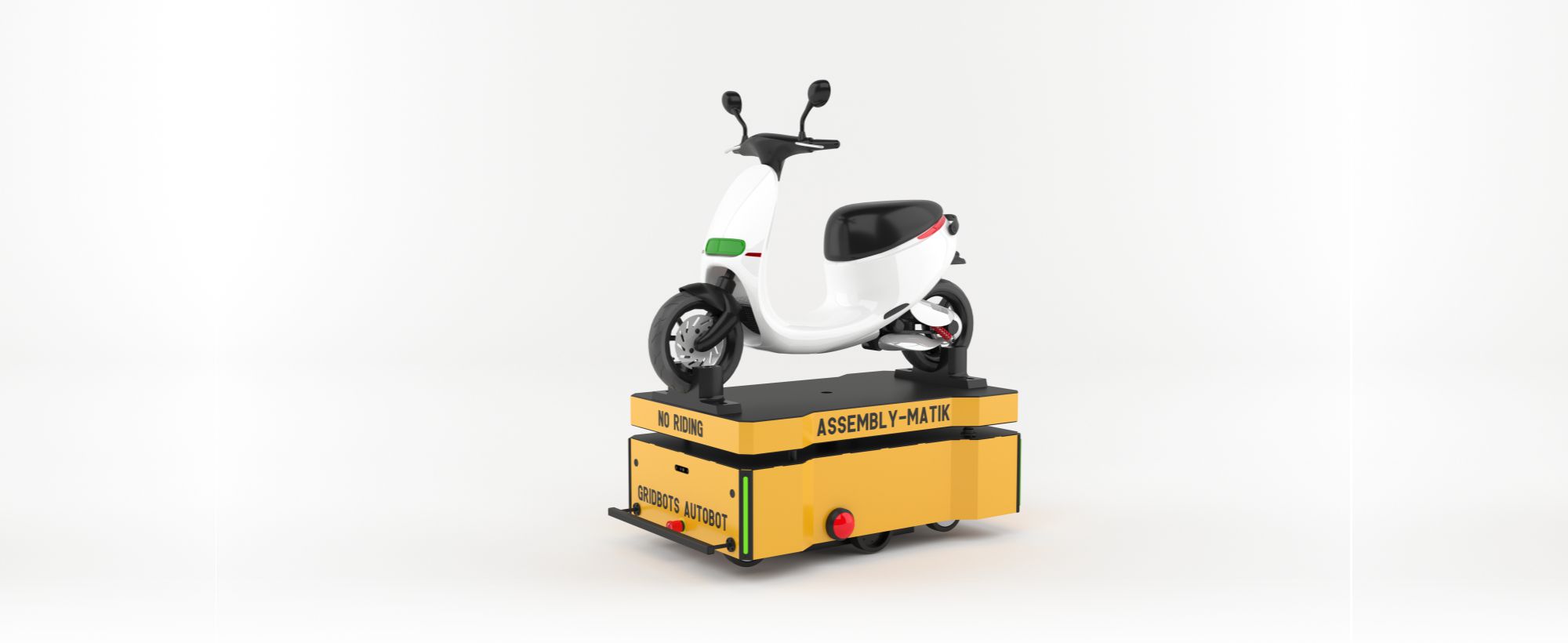
Gridbots AssemblyMATIK is a series of autonomous heavy-payload mobile assembly platforms designed to transform conventional fixed assembly lines into flexible, mobile manufacturing systems. With payload configurations ranging from approximately 1 tonne to 10 tonnes, AssemblyMATIK carries the product, sub-assembly or workpiece on its own platform while assembly operations are performed directly on the robot.
Instead of moving products manually or transferring partially completed assemblies between fixed conveyor stations, AssemblyMATIK itself becomes the mobile assembly carrier. The product remains mounted on the same platform while the AMR autonomously moves from one assembly station to the next. Each station performs a defined operation, after which the AssemblyMATIK platform transports the product to the next operation in the manufacturing sequence.
This enables a fundamentally different production-line architecture in which the product moves autonomously through the factory while the assembly stations remain fixed — particularly advantageous for large, heavy or high-value products that are difficult to move using conventional conveyors, forklifts or cranes.
A typical line can consist of multiple AssemblyMATIK units operating between dedicated stations such as chassis assembly, electrical installation, hydraulic installation, mechanical assembly, inspection, testing, calibration and final assembly. Each unit automatically docks at a station, remains stationary while work is performed, and then proceeds to the next station according to the production sequence.

1 – 10 TONNES
Payload Capacity

MOBILE STATION
Assembly On-Platform

STATION-TO-STATION
Autonomous Transfer

FLEET MODE
Multi-AMR Supervision
1–10 tonne scalable payload configurations

Mobile assembly station carries product through the process

Autonomous station-to-station movement

Product remains on one platform — less lifting & re-fixturing

Flexible line — stations rearranged without redesigning conveyors
Precision programmable docking at each assembly station
Custom fixture interface — pallets, jigs, clamps, product fixtures

PLC / MES / ERP & production-scheduling integration

Safety-rated sensing, E-stops, warning & controlled-access zones
| Feature | Description |
|---|---|
| 1–10 tonne payload capability | Scalable platform configurations for light, medium and heavy product assemblies. |
| Mobile assembly station | The AMR carries the product throughout the complete assembly process. |
| Station-to-station movement | Autonomously transports products between predefined manufacturing stations. |
| Product remains on one platform | Reduces repeated lifting, loading and unloading of heavy assemblies. |
| Flexible line configuration | Production stations can be rearranged or expanded without redesigning a fixed conveyor. |
| Precision docking | Programmable positioning at assembly stations for repeatable work access and hand-off. |
| Custom fixture interface | Top deck can be engineered for pallets, jigs, clamps and dedicated product fixtures. |
| Manufacturing-system integration | Interfaces with PLCs, MES, production scheduling and station-control systems. |
| Fleet operation | Multiple AssemblyMATIK units operate simultaneously under supervisory fleet management. |
| Safety architecture | Safety scanners, emergency stops, warning systems and controlled access zones. |
| Step | Operation | Description |
|---|---|---|
| 1 | Product Loading | The product, chassis or major assembly is placed and secured on the AssemblyMATIK platform. |
| 2 | Initial Assembly | The first manufacturing operation is performed directly on the product while it remains on the AMR. |
| 3 | Autonomous Transfer | AssemblyMATIK moves the product to the next designated production station. |
| 4 | Precision Docking | The AMR positions itself at the station and establishes the required working position. |
| 5 | Station Operation | Operators or automated equipment perform the next assembly, inspection or testing operation. |
| 6 | Production Sequence Update | The manufacturing-control system releases the AMR for the next operation. |
| 7 | Repeat Transfer | Station-to-station movement continues until final assembly and testing are completed. |
| 8 | Finished Product Release | The completed product is moved to final inspection, dispatch or finished-goods staging. |
| Station | Typical Operation |
|---|---|
| Station 01 | Product loading / initial assembly |
| Station 02 | Mechanical sub-assembly |
| Station 03 | Electrical installation |
| Station 04 | Hydraulic / pneumatic installation |
| Station 05 | Component integration |
| Station 06 | Functional assembly |
| Station 07 | Inspection / dimensional verification |
| Station 08 | Testing / calibration |
| Station 09 | Final assembly |
| Station 10 | End-of-line inspection / dispatch |
| Heavy industrial equipment assembly | Construction and agricultural machinery |
| Automotive and specialty vehicle assemblies | Defence and large equipment platforms |
| Robotic and automation equipment | Large machine and machine-base assembly |
| Electrical and hydraulic system integration | Large welded structure and fabricated assembly |
| Inspection, testing and end-of-line operations | High-mix, small-batch flexible production |
| Model Series | GB-AMR-ASSEMBLY-MATIK-X |
| Payload Class | 1 – 10 Tonnes (depending on model and application) |
| Application Environment | Indoor industrial manufacturing facilities |
| Primary Function | Autonomous movement of products between assembly stations |
| Platform Function | Mobile product fixture / mobile assembly workstation |
| Product Mounting | Custom pallet, fixture, jig or direct deck mounting |
| Navigation | Autonomous navigation selected per factory environment and layout |
| Station Docking | Programmable precision docking at assembly stations |
| Fleet Operation | Single or multiple AMRs under supervisory control |
| Safety | Safety-rated sensing and emergency-stop architecture as required |
| Integration | PLC, MES, ERP, production scheduling and factory automation interfaces |
| Product-Specific Fixtures | Workholding and jig arrangements on top deck |
| Utility Interfaces | Electrical, pneumatic and hydraulic supply provisions |
| Tooling Provisions | Tool mounting and operator-assistance equipment |
| Work Positioning | Optional powered lift, indexing or positioning mechanism |
| Identification | Barcode / RFID product and order association |
| Traceability | Product, fixture and production order linked to AMR mission |
| Reduces dependence on fixed conveyors for heavy products. |
| Minimizes repeated crane, forklift or transfer operations between assembly stages. |
| Keeps the product on a common fixture / platform through multiple operations. |
| Allows assembly stations to be rearranged without major conveyor modifications. |
| Supports multiple product variants on the same manufacturing floor. |
| Enables production routing based on product configuration and process requirements. |
| Makes it easier to add parallel stations when production volume increases. |
| Can reduce floor-space requirements associated with large fixed transfer systems. |
| Improves traceability by associating a product and its process with an individual AMR mission. |
| Creates a scalable pathway toward automated, data-driven manufacturing. |
Charts below are representative/illustrative and intended for presentation. Replace the values with your project-specific data.
Representative platform configurations (tonnes)
Illustrative share of cycle across a 10-station line
Illustrative comparison across key attributes (higher = better)
Illustrative scaling as AssemblyMATIK units are added